Tag: SimplyConvert Solutions

  • AAJ Trial Magazine Feature: Jumpstart Your AI Journey

    AAJ Trial Magazine Feature: Jumpstart Your AI Journey

    The potential uses for generative Al and large language models run the gamut. Start exploring how to implement this technology in your practice.

    Click here to download this article as PDF  |  Reprinted with permission of Trial® (June 2024)

    In November 2022, OpenAI launched ChatGPT, a generative-Al large language model (LLM) chatbot.1 It was a revolutionary technology with the capability to write effective computer code, compose music, draft research papers, create comprehensive business plans, generate Excel formulas, and even give relationship advice. By January 2023, ChatGPT had over 100 million users.2

    This technology’s immense potential also brought panic. Its ability to believably mimic student-created work sent shockwaves through the education field, resulting in calls to ban students from using the technology.3 Last year’s television and film writers strike was driven in part by substantiated fears that studios would increasingly turn to Al to write scripts.4 And financial powerhouses such as Bank of America, Goldman Sachs, and JPMorgan restricted employee access to ChatGPT.5

    The legal field is no exception. Some lawyers have faced consequences for using ChatGPT for research and submitting court filings that referenced cases that didn’t exist.6 Despite the early trepidations, a recent study found that 73% of lawyers plan to use generative AI at work within the next year.7

    At this point, we all know that AI is here to stay. Many will be able to leverage the technology to improve their research and writing-and ultimately streamline litigation. But this technology is new, and ethical guidelines are still being developed. Here’s a practical guide to using generative AI effectively and responsibly.

    What Is Generative Al?

    When asked to define “in layman’s terms” what generative AI is, ChatGPT explained it as “computer programs or systems that can create new content or data, such as text, images, or music, without being explicitly programmed for each specific output.”8

    Generative AI differs from traditional AI (also known as “weak Al” or “narrow Al”) in that the traditional models are designed to perform specific tasks or solve specific problems within predefined boundaries, without the ability to adapt or learn from new data beyond their initial programming or to create new content.9

    In other words, generative AI is unlike other computer systems because it can instantly sift through enormous amounts of data, learn from that data, and then make decisions based on what it has learned while factoring in previous training and user interactions. Essentially, generative Al processes information in a manner comparable to humans, except exponentially faster and with the ability to process larger amounts of information all at once.

    Checks and Balances

    As we enter the age of AI, lawyers need to establish checks and balances around their use of this technology. With the great power Al can provide also comes a great responsibility to use it ethically. It’s important to establish a framework of considerations to keep in mind, especially as generative Al technology continues to evolve. This framework should include:

    • Accountability. Understand Al’s capabilities and limitations and consider anything it produces for you or your practice as an extension of yourself. Al’s mistake is your mistake.
    • Transparency. As a leader of your firm, it’s essential that you set clear guidelines for what Al can and can’t be used for, in conjunction with open and honest discussions of the topic with your team. For example, this can be in the form of an AI handbook that outlines specifically when the technology can be used (such as for summarizing large amounts of anonymized data or information into a more digestible format) and when it can’t be used (such as for drafting entire complaints or motions).
    • Data privacy and confidentiality. You must educate yourself and your staff on the privacy and confidentiality risks associated with AI and how to minimize those risks. Specifically, this means teaching your team how to anonymize potentially sensitive data before uploading it into an LLM.
    • Professional responsibility. Attorneys have a responsibility to engage in constant study and education on both the law and its practice. This includes the ever-evolving role of technology. Generative Al is meant to supplement-not replace—a lawyer’s knowledge.

    What Al Can’t (or Shouldn’t) Do

    Artificial intelligence is far from perfect. Particularly, Al occasionally “hallucinates,” confidently producing incorrect or nonsensical responses.10 Therefore, it’s imperative that lawyers review everything that Al tools produce. It is best practice not to take AI at face value. Instead, use it as a supplemental tool to summarize data or documents, organize your thoughts, or even take the first attempt at drafting content. Al should never be used to write a motion that is then filed without any review, for example. Artificial intelligence should never act as a replacement for the human reasoning and judgment that will always remain an essential component of legal practice.

    Data security is also a paramount concern. LLMs, by default, keep a running record of everything you input to learn and improve. It’s also possible for generative AI software to be hacked. Therefore, any confidential case or client data should be redacted or anonymized before inputting it into an LLM.

    Also keep in mind that AI has been found to elicit gender and racial biases in the content it produces.11 This reinforces the need to always make sure a human set of eyes reviews everything produced by AI-from a filing to a client email-before it leaves your office.

    How Can Generative Al Be Used?

    Generative Al can help you and your firm litigate and operate more efficiently. Here are some ways you can use this technology.

    Legal research and summarization. Generative Al is a potential gamechanger when it comes to legal research and analysis. Instead of spending countless hours sifting through documents, medical records, peer-reviewed studies, and other research materials, lawyers and paralegals can drop these documents into an LLM and prompt the software tool to present a summary based on their desired criteria.12 (Remember: It is crucial to redact or anonymize any confidential or client data before using an LLM tool to protect privacy and confidentiality.)

    For example, if a client is alleging a back injury caused by a defendant’s negligence, instead of combing through hundreds of pages of medical records to put together a chronology to support causation, plug the anonymized records into the LLM and prompt it to create the chronology for you-which it can do in seconds.

    Now, consider this capability on a larger scale, say in multidistrict litigation with thousands or tens of thousands of claimants. The ability to summarize a lifetime of medical history and identify causation in seconds for thousands of claimants would save time and resources. For example, since generative Al tools can process large amounts of data and identify patterns based on what the user asks of them, you could enter someone’s anonymized medical history and ask the tool to pull out every time treatment was provided for a specific injury.

    As a research assistant, generative Al can help lawyers glean valuable insights from overwhelming amounts of data-it can help identify the information most pertinent to the litigation, enhance efficiency, and better inform decisions. By using AI, lawyers can avoid getting lost in the information overload that can often hinder traditional research methods. Sometimes “more” can mean more complexity and confusion, but AI can point legal professionals toward the critical data they need to avoid falling down data rabbit holes.

    Intake. Generative Al can streamline client intake for firms, saving time and money. It can automate the initial interaction with potential clients and help create a smooth and efficient process from the beginning. And it can swiftly gather and analyze relevant information for personalized client communications.

    Law firms can provide clients with 24/7, real-time updates on their cases through LLM chatbot solutions embedded within their websites. Additionally, Al-powered case evaluation software can — using personalized, preset criteria — review cases for intake and move relevant claims forward for attorney review. Used correctly, AI empowers law firms to provide a higher standard of service and foster stronger client relationships.

    However, it’s essential for firms to find the right software partner that not only understands AI but also understands the unique complexities of the plaintiff bar. An Al chatbot solution provider that works primarily with online clothing stores, for example, likely won’t be able to properly tailor their solution to uniquely suit your firm.

    Deposition assistance. Depositions can be extremely time-consuming, and it’s often difficult to parse transcripts and pull out the revelations that can make a case. Artificial

    intelligence can help ease the burden of sorting through lengthy depositions. While live transcription is nothing new, transcription tools integrated with generative AI can analyze the transcripts and, in real time, automatically separate important responses. Additionally, AI can immediately flag relevant documents and exhibits based on responses from the deponents and can note pauses, unusual body language, and discomfort during live depositions.

    Jury selection. In the context of assembling profiles about potential jurors, Al uses advanced data analysis techniques to assess potential jurors’ backgrounds, social media activity, and public records. It can identify patterns, biases, and attitudes that might impact the case. This information helps you make informed decisions during jury selection and can increase the likelihood of selecting an unbiased jury.

    Damages analysis. Generative AI can analyze large volumes of legal precedents, case histories, and relevant data to estimate potential damages in a more accurate and consistent manner than human analysis. It can consider a range of factors, such as past verdicts, economic indicators, and the specific circumstances of the case to provide a data-driven assessment of potential damages. This aids lawyers in determining the appropriate amount for settlement offers or in presenting compelling damages arguments in court.

    Transactional law. Lawyers can use generative AI to automate essential but tedious contract-related functions, allowing more time for strategizing and negotiating. Specifically, generative Al can ensure lengthy contracts are uniformly formatted within seconds, streamline version control to ensure changes and revisions are accurately tracked, review and assess boilerplate clauses, and instantly proofread documents for typos and grammatical

    Virtual legal assistants. Large language models can carry out many of the same tasks as a legal assistant but, in some cases, with greater efficiency. These tools are great notetakers, scheduling assistants, and inbox organizers. They can help organize your thoughts into cohesive emails to clients, opposing counsel, and insurance companies.

    Of course, using Al as a personal legal assistant takes time and effort. Just like a human legal assistant, there’s a learning curve for you and the LLM. You need to learn how to correctly prompt it to produce the desired response. It needs time to improve its functionality based on repeated interaction. And you should always double check everything AI produces for tone and accuracy.

    Generative Al has taken the world by storm and ushered in a transformative era for legal professionals. Its potential to enhance overall efficiency is undeniable.

    But it’s also essential to recognize that AI is fallible and must be used judiciously.

    Lawyers must exercise caution, ensuring AI supplements rather than replaces the human decision-making necessary to litigate clients’ cases effectively and ethically. It’s imperative to maintain data security and address potential biases in AI-generated content. If used responsibly, Al can enhance your speed and effectiveness as a trial lawyer, providing a strategic advantage in the fight to deliver justice on behalf of clients.

    The views expressed in this article are the author’s and do not constitute an endorsement of any product or service by Trial or AAJ.

    Copyright ©2024 American Association for Justice®, Formerly Association of Trial Lawyers of America (ATLA)

    1  Bernard Marr, A Short History of ChatGPT: How We Got to Where We Are Today, Forbes (May 19, 2023), https://www.forbes.com/sites/bernardmarr/2023/05/19/a-short-history-of-chatgpt-how-we-got-to-where-we-are-today/?sh=5187e78a674f

    2 Martine Paris, ChatGPT Hits 100 Million Users, Google Invests in AI Bot and CatGPT Goes Viral, Forbes, Feb. 3, 2023,  https://www.forbes.com/sites/martineparis/2023/02/03/chatgpt-hits-100-million-microsoft-unleashes-ai-bots-and-catgpt-goes-viral/

    3 Kalhan Rosenblatt, ChatGPT Banned From New York City Public Schools’ Devices and Networks, NBC News, Jan. 5, 2023, https://www.nbcnews.com/tech/tech-news/new-york-city-public-schools-ban-chatgpt-devices-networks-rcna64446

    4 Andrew Dalton & The Associated Press, Writers Strike: Why A.I. Is Such a Hot-Button Issue in Hollywood’s Labor Battle With SAG-AFTRA, Fortune, July 24, 2023, https://fortune.com/2023/07/24/sag-aftra-writers-strike-explained-artificial-intelligence/

    5 Brian Bushard, Workers’ ChatGPT Use Restricted at More Banks — including Goldman, Citigroup, Forbes, Feb. 24, 2023, https://www.forbes.com/sites/brianbushard/2023/02/24/workers-chatgpt-use-restricted-at-more-banks-including-goldman-citigroup/#:~:text=CitiGroup%2C%20Bank%20of%20America%2C%20Deutsche,has%20taken%20the%20internet%20by

    6 Pranshu Virma & Will Oremus, These Lawyers Used ChatGPT to Save Time. They Got Fired and Fined., Wash. Post, Nov. 16, 2023, https://www.washingtonpost.com/technology/2023/11/16/chatgpt-lawyer-fired-ai/

    7 Wolters Kluwer, Future Ready Lawyer 2023 Report, https://www.wolterskluwer.com/en/know/future-ready-lawyer-2023

    8 This is the output from a prompt entered into ChatGPT.

    9 Agilsium, Generative AI vs. Traditional AI: A Simple Breakdown, https://www.agilisium.com/blogs/generative-ai-vs-traditional-ai-a-simple-breakdown#:~:text=Generative%20AI%3A%20Creativity%20and%20Data%2DDriven%20Learning&text=Unlike%20Traditional%20AI%2C%20Generative%20AI,from%20vast%20amounts%20of%20data.

    10 IBM, What Are AI Hallucinations?, https://www.ibm.com/topics/ai-hallucinations.

    11 Xiao Fang et al., Bias of AI-Generated Content: An Examination of news Produced by Large Language Models, 14 Sci. Reports 5224 (2024), DOI: https://doi.org/10.1038/s41598-024-55686-2.

    12 To learn more about how LLMs work, see Alex Freeburg & Erik Dahl, Large Language Model Fundamentals, Trial, Mar. 2024, at 46.


  • Make it Rain with One Simple Change to Your Website

    Make it Rain with One Simple Change to Your Website

    One simple change to your website could increase your legal fees by millions and your return on marketing dollars by over 2,000%

    Yes, you read that correctly. All it takes is the addition of one snippet of code to transform your site into a client intake-optimized, money-making machine.

    Sound too good to be true? It’s not. And hundreds of law firms are already watching their case and referral numbers grow as a result of making the switch to SimplyConvert.

    If your firm is still using live chat, it’s time to upgrade your intake system. Your 2010 solution to 24/7 digital engagement with potential clients is costing you opportunities and money. Below are the results of a 54-month study we conducted on a firm that switched from live chat to SimplyConvert and capitalized on ALL that SimplyConvert has to offer. We think you’ll agree that the results are astounding and we invite you to schedule a demo for your firm. 

    Meet with Us Email CTAs-1

    Case Study

    How One Law Firm Realized Millions in Legal Fees and Increased its Marketing ROI by more than 2,000% by Switching from Live Chat to SimplyConvert

    About the study:

    • Conducted over 54 months (27 months with live chat, followed by 27 months with SimplyConvert)
    • Firm relied on a well-known live chat service provider to field inquiries from potential clients visiting its website for first 27 months
    • Firm switched to SimplyConvert and ensured that they took advantage of all the platform’s included features

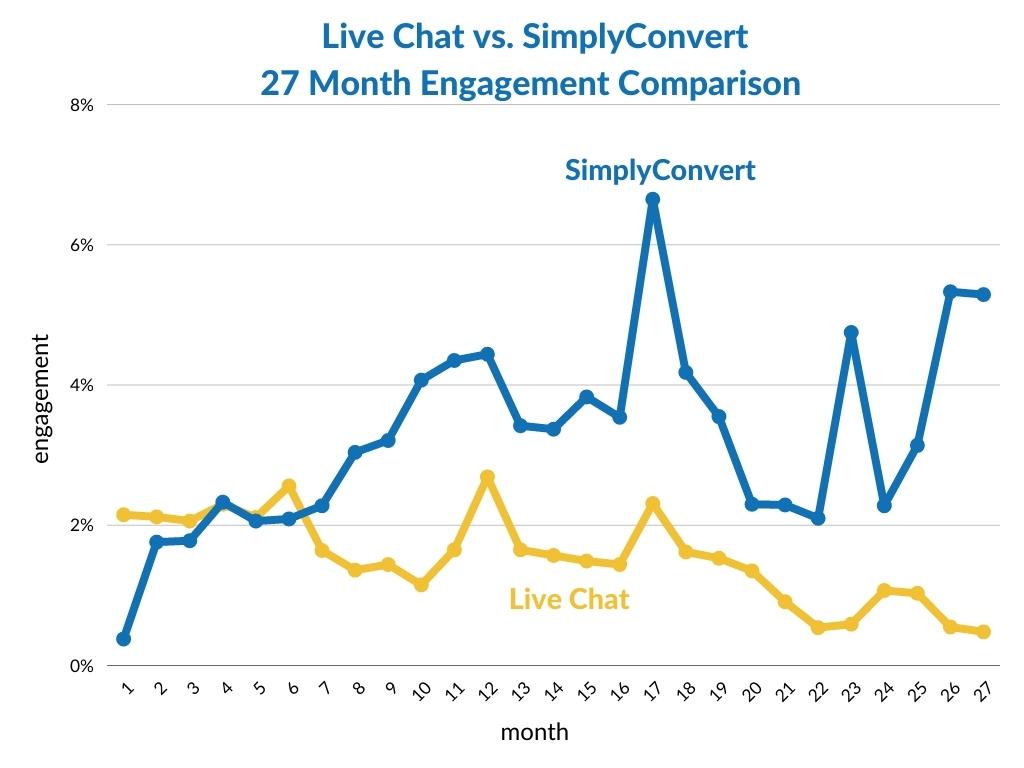
    Finding #1: SimplyConvert Increases Engagement with Potential Clients.

    One of the first benefits of switching from live chat to SimplyConvert that the firm noted was an increase in engagement with its website visitors. In fact, engagement with potential clients more than doubled after making the change. 

    Unlike live chat, static forms, or DIY chatbots, SimplyConvert provides instant legal guidance at the moment the consumer intends to hire a lawyer. Engagement rates increase over time as SimplyConvert learns the needs of your potential clients. 

    Whether your firm specializes in a single area of law or 50 different litigation areas, SimplyConvert ensures you have a criteria-based chat conversation ready for every new litigation.

    The bottom line: better client experiences = better engagement percentages. 

    Project Management Timeline Infographic Graph-1

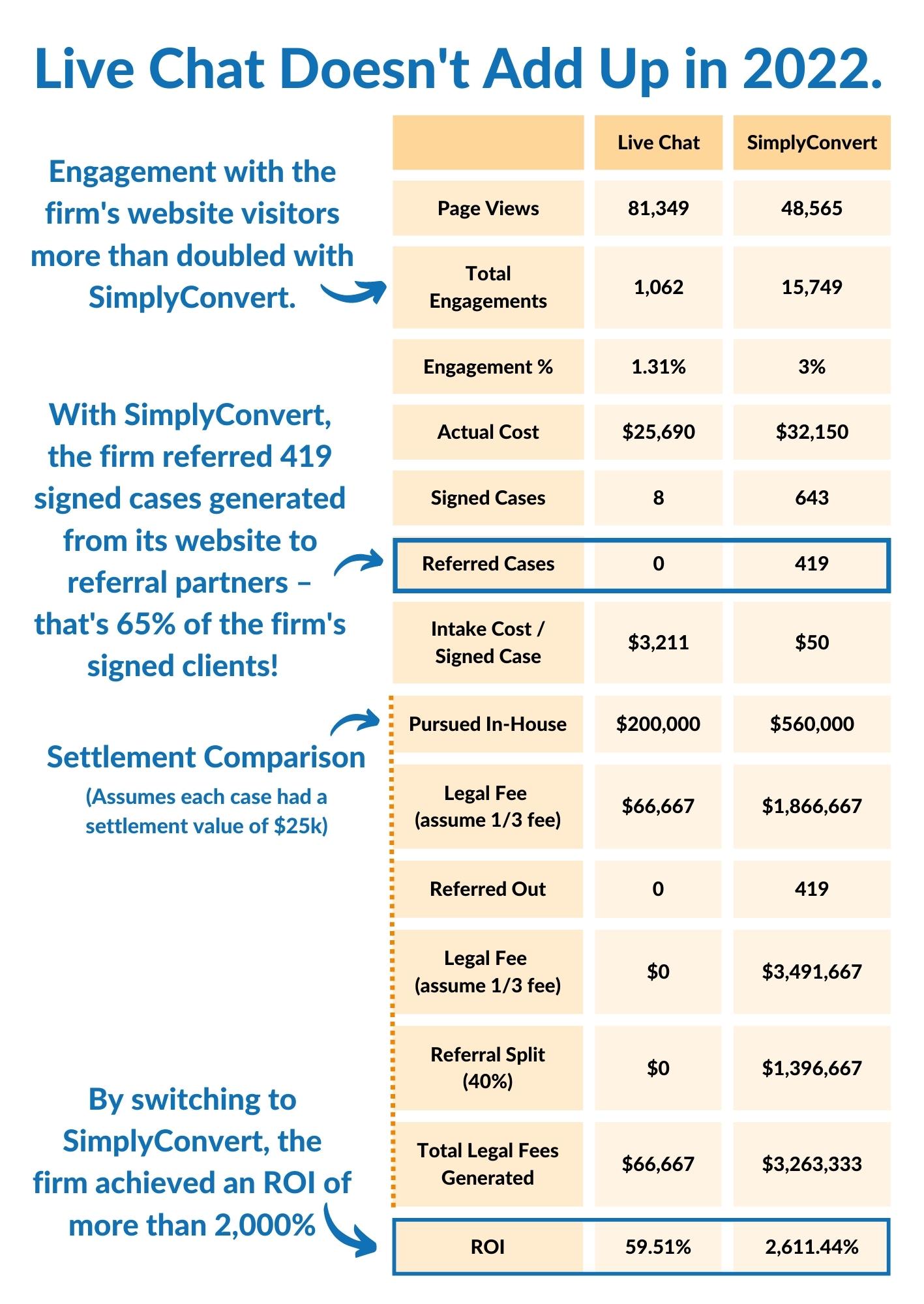
    Finding #2: SimplyConvert Signs More Cases – 635 to be exact.

    During the 27 months our test law firm used live chat, they signed only eight clients at a total cost of $25,690. That means each client cost the firm $3,211. Ouch

    Conversely, the firm signed 643 clients at a cost of $32,150 in the first 27 months of using SimplyConvert. That’s $50 per signed client — what we like to call success-based pricing.

    The 8 clients that were signed during the live chat days of our test law firm would have cost only $224 if SimplyConvert had something to say about it. SimplyConvert understands the challenges of budgeting your legal resources, which is why you pay only for signed clients, not conversations. When you win, we win. 

    Finding #3: SimplyConvert Firms Refer Cases to Each Other.

    SimplyConvert isn’t just a client engagement platform — it’s a community. We designed SimplyConvert to allow law firms to instantly refer signed and potential cases to trusted legal partners. And, if your state bar allows it, we have some great partners for you to meet who will be happy to split fees with you.

    During the 27 months our test law firm used SimplyConvert, the firm referred out 419 of the signed cases they generated from their website — 65% of their signed clients!

    Back when the firm was using live chat, referring a case meant getting on a listserv and searching for a lawyer that could assist the legal consumer — a process that took too much time. Rather than go through this labor-intensive process, the firm simply rejected the chat and moved on. Today, the firm is building a SimplyConvert referral network; 419 cases is just the start! 

    Live Chat Doesnt Add Up in 2022-2

    Schedule Demo

  • 5 tips for making a great first impression on new clients

    5 tips for making a great first impression on new clients

    Implementing SimplyConvert’s chatbot to intake new clients through your website is a significant first step towards becoming a more client-centered law firm. But to ensure you’re making a great first impression when it comes to new clients, you need to take the time to look at your entire intake process from start to finish.

    Before you begin, it’s important to remember the following guiding principles:

    • Approach with empathy. The point of this exercise is to improve your client’s experience. Think about the best and worst client experiences you’ve had in your own life and put yourself in the client’s shoes. Ask yourself what parts of your firm’s intake process work really well and what parts need improvement.
    • Look for opportunities to incorporate technology. When the right tools are implemented the right way, technology can help you make a great first impression on your new client. Look for parts of the process that can be automated for time and efficiency gains.

    With that, here are five tips to make sure your client intake process sends the right message about you and your firm and reassures your clients that they’ve made the right decision in hiring you.

    TIP #1:

    Write/draw out your new client intake and onboarding process from start to finish and include how long it takes to complete each step.

    Once you have your process in front of you, examine each step through the lens of a new client.

    • Look at how much time passes between a client signing your retainer agreement and the first live conversation with you or another member of your firm. What can you do to shorten that timeframe?
    • Look carefully at the language in your written communication and ask yourself whether it’s understandable. Does it contain legal jargon that the average client wouldn’t understand?
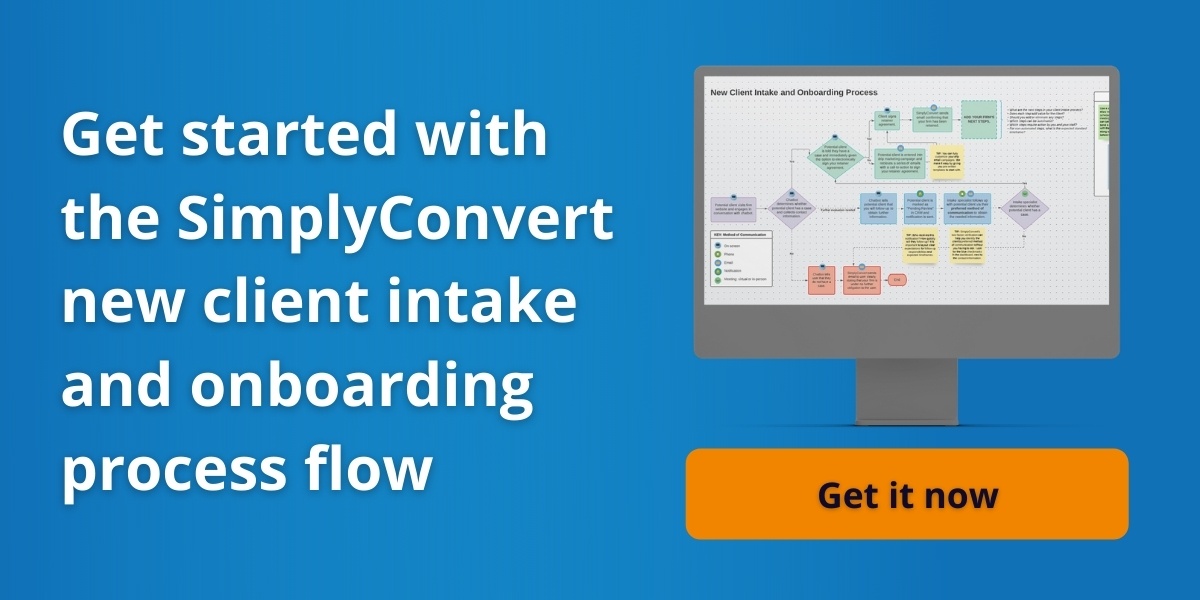
    • Use our example flowchart as your starting point. We’ve included all the client intake steps that the SimplyConvert platform handles for you. Simply add the steps that your firm takes after SimplyConvert signs the client and notifies you of the new case.

    New call-to-action

    TIP #2:

    Customize your drip follow-up campaigns and don’t be afraid to get creative.

    Firms using SimWhat Is Drip Marketing?plyConvert have access to pre-written drip messaging that addresses common concerns and encourages prospective clients to sign a contract to retain your law firm. Once a client signs the contract, SimplyConvert’s template follow-up email provides them with a copy of the agreement, contact information for your firm, and guidance on what will happen next.

    Beyond simply including your firm logo, you have the ability to fully customize these messages with your own content and media. For example, you may wish to include a link to a blog post you wrote explaining a certain topic when encouraging a prospective client to sign your retainer agreement or include a video introducing key staff members in your welcome email.

    Mike Morse Law Firm created a welcome video to provide clients with an immediate touchpoint after they sign a contract through the SimplyConvert client portal. The video tells their clients what to expect next from the firm and communicates important information about what clients should do if they are contacted by parties affiliated with the defendant. Click here to hear how Mike personally introduces his firm.

    The sky is the limit when it comes to customizing your drip communication campaigns on the SimplyConvert platform.

    TIP #3:

    Follow up with new clients as quickly as possible.

    We can’t emphasize this enough: your timeliness in reaching out to a new client after they sign your retainer agreement can make or break your relationship.

    SimplyConvert notifies you the instant a contract is signed. From there we recommend creating a procedure to ensure that each new client hears from you according to the follow-up standard you set. Automation tools can help ensure that your follow-up process happens no matter what — whether you’re out of the office or attending to other matters.

    It’s up to you to determine your follow-up time standard, but the survey results for consumer expectations when hiring a lawyer in Clio’s 2020 Legal Trends Report can serve as a helpful guide. Clio asked consumers how quickly they expect a response when leaving a phone message or sending an email to a firm they’re considering hiring. 10% of respondents said they expect a response within an hour, 24% within a few hours, and 45% within 24 hours. That means waiting more than 24 hours to respond misses the expectations of 79% of those that reach out. Only 5% said they would expect a response beyond 72 hours.

    First impression blog post graphics 1
    TIP #4:

    Simplify meeting scheduling.

    There’s no need to go back and forth over email trying to nail down a time to meet. Set parameters for the times you are available for new client calls in your calendar and connect it to a scheduling app such as Calendly or YouCanBook.me. You can then include a link in your email and allow the client to select a time for your first meeting. (Another tip: be sure to turn on the meeting reminders to remind the client about the meeting ahead of time.)

    Think about whether you want to give your clients the option to meet in person or virtually. As Clio’s 2020 Legal Trends Report indicates, many clients may opt for virtual meetings when given the choice: 

    • 37% of consumers now prefer videoconference when meeting their lawyer for the first time
    • 50% of consumers prefer to meet via videoconference for follow-up meetings
    • 52% of consumers believe that most legal matters can be handled remotely.

    If you plan to conduct the meeting virtually, be sure to plug in your Zoom or GoToMeeting credentials so that the app can drop a meeting link and call-in information right into the calendar invite.

    First impression blog post graphics 3

    TIP #5:

    Prepare for your first conversation with the client.

    A tremendous advantage to using SimplyConvert’s chatbot for intake comes in preparing for your firm’s first live conversation with the client. With the facts of the case collected by the bot, you can ensure the right person from your firm conducts the initial meeting. For example, if a motorcycle case comes in and you have a paralegal or attorney on staff who is an avid rider it might be advantageous to have them be the first person to reach out to the client. Likewise, if a sexual assault case comes in and you have someone on your team that’s trained in speaking with trauma victims, that person should have the initial meeting with the client.

    Knowing the details of the case ahead of time also gives you time to conduct any research you may need before the first live conversation. Learning as much as possible about a case before the first meeting shows that you care about the client and you are invested in the outcome of their case.

    Following these tips can help you make a great first impression on your clients, starting the relationship on the right foot.

    Schedule Demo

  • Is TCPA compliance a liability lurking in your blind spot?

    Is TCPA compliance a liability lurking in your blind spot?

    Is your law firm fully compliant with the Telephone Consumer Protection Act or TCPA? 

    Do you outsource your advertising and intake to any third parties? If so, are your vendors’ systems and processes compliant with stringent TCPA rules? How can you be sure? 

    Did you know that a single violation could cost you $500? Read that again: a violation isn’t the total outreach to a client, it’s a single text. So, if your advertising firm uses auto-dialed calls and/or automated texting without getting proper opt-in, you could be responsible for thousands of dollars of violations per client.  

    A quick overview of the TCPA

    The TCPA was passed by Congress in 1991 and signed into law by President George H.W. Bush, amending the Communications Act of 1934. It restricts phone solicitations — or telemarketing — and the use of automated telephone equipment, limiting the use of auto-dialing systems, prerecorded voice messages, SMS text messages, and fax machines. It also requires that entities provide identification and contact information in their messages. 

    Here are some of the rules under the TCPA that businesses must abide by unless they have prior express consent: 

    • Cannot call residences before 8 a.m. or after 9 pm, local time
    • Must maintain a company-specific “do-not-call” (DNC) list of consumers who asked not to be called; the DNC request must be honored for 5 years
    • Must honor the National Do Not Call Registry
    • Must provide their name, the name of the person or entity on whose behalf the call is being made, and a telephone number or address at which that person or entity may be contacted
    • Cannot solicit residences with an artificial voice or a recording
    • Cannot send unsolicited advertising faxes

    The penalties for violating the TCPA are steep:  

    • In the event of a violation, a subscriber may (1) sue for up to $500 for each violation or recover the actual monetary loss, whichever is greater, (2) seek an injunction, or (3) both.

    • In the event of a willful violation of the TCPA, a subscriber may sue for up to three times the damages, i.e. $1,500, for each violation. (Source: Wikipedia: Telephone Consumer Protection Act of 1991)

    If your law firm outsources its advertising and/or client intake functions to a third party that is not abiding by the TCPA you could be left holding the bag. 

    Protecting yourself 

    So, how do you know if your firm is using a marketing firm that is TCPA compliant?  

    Understand the advertising process and the landing pages where clients find you. If your advertiser/marketer can’t show you every step, run away. 

    If your firm uses SimplyConvert for advertising and client intake support, you can stop worrying. We’ve not only built a platform that is TCPA compliant, but also GDPR and HIPAA compliant so that law firms using our technology can rest assured they’re not violating these important laws without having to dive deep into the regulation weeds. (You can read more about SimplyConvert’s privacy practices here.)  

    Scammers are using the TCPA to target law firms for a quick buck 

    Last month, a SimplyConvert law firm was targeted by a scammer who thought he could make a quick buck by threatening to sue the firm over TCPA violations. Here’s what happened:  

    The man retained the lawyer’s firm to represent him in a mass tort lawsuit. Shortly after, the lawyer received an email stating that the firm had committed two violations in contacting him:

    Attached to the email was a letter of intent to sue and a letter stating that the matter would be dropped if the law firm sent a check for $3,000: 

    Thankfully, the law firm was protected because it uses SimplyConvert for client intake. SimplyConvert ensures that potential clients proactively opt-in to receiving communications BEFORE they can proceed with signing a firm’s contract. The law firm was able to quickly dismiss the matter — the man had provided his contact information and phone number and prior express written consent to be called/texted. 

    The bottom line

    It’s important to take the time to ensure your firm’s advertising and client intake methods are entirely TCPA compliant. Knowing that your firm is doing right by consumers will not only give you peace of mind, it could also save you from a major headache, hefty fines, and protect you from scammers looking for a quick payout.

    SimplyConvert privacy policy

  • Live chat to chatbot: 3 reasons you won’t regret making the switch

    Live chat to chatbot: 3 reasons you won’t regret making the switch

    What started as a solution to keep the virtual office lights on 24/7 for many law firms has turned out to be an inefficient and ineffective way to interact with prospective clients. Live chat modules are everywhere, but they’re not delivering the results they promised. The impact has severe implications for law firm pipelines: prospects are closing their browsers and moving on.

    So how can firms maintain round-the-clock availability and engage with clients in a more meaningful way?

    Enter the first artificial intelligence-powered chatbot specifically created for law firms by a lawyer: SimplyConvert.

    Firms that have made the switch to Simply Convert’s chatbot find that their costs for engaging with prospects online have decreased, while the quality of leads from their websites has risen dramatically. Here are three reasons why you won’t look back after replacing your live chat service with SimplyConvert:

    1. Eliminate the noise. SimplyConvert’s chatbot runs on criteria-based questions and keeps the conversation focused on gathering relevant information, so you and your staff aren’t left reading through pages and pages of wandering live chat transcripts. You are instantly notified when a prospective client meets your custom criteria and you’ll both know up-front whether they have a case. Increasing the efficiency of your lead qualification and intake processes allows you and your staff to focus on your actual casework.
    2. Better serve your clients. Chatbots allow you to maintain 24/7/365 availability so that you can engage with clients on their time, not only when it’s convenient for you and your staff. That means the third-shift worker or the new mom scrolling the internet in the middle of the night can engage with your firm and even retain you to represent them outside of regular business hours.
    3. Maximize your advertising dollars. The chatbot is just one feature of Simply Convert’s powerful platform. With its integrated legal CRM, SimplyConvert not only helps you manage relationships with potential and signed clients from all lead sources, but it also aggregates all of your data into a comprehensive and intuitive dashboard. You will quickly be able to discern how well your advertising campaigns are working, allowing you to make data-driven decisions about your marketing dollars.

    Experience the difference yourself: schedule a demo today and ask about our 30-day free trial.

    Schedule a demo

  • 3 Lessons Learned from a Pandemic-Proof Law Firm

    3 Lessons Learned from a Pandemic-Proof Law Firm

    The U.S. business landscape radically shifted in March 2020 due to the coronavirus, and law firms across the country are not immune to the challenges faced by changes in the workforce.  However, some law firms have proven to be uniquely suited to the pandemic and have seen an uptick in clients and potential revenue. 

    The events of 2020 should serve as a catalyst for law firms to consider what a better normal looks like even beyond the pandemic. 

    Pandemic-proof law firms are lean, agile and adaptable. They understand the evolving needs of today’s legal consumer and have the tools to assist them in weathering a slump in demand of their traditional legal services.  

    Portrait of a Pandemic-proof Law Firm

    Despite the disruption to their workflow one personal injury law firm has found a way to thrive during the pandemic. This law firm is a personal injury practice that traditionally relies on trials, depositions and hearings to generate revenue. They also rely on a pool of clients who are now unable to leave their homes due to quarantine. 

    Without a shift in their business model, this would be a firm that should be considering cost-cutting measures very soon. Instead, this pandemic-proof firm has not only weathered the storm but has thrived. 

    During the time frame of March to September 2020, this firm saw an increase in client intakes of nearly 4,000% over the same time frame in 2019. In addition, the pandemic-proof law firm also saw an increase of 3,200% in signed clients during this time.

    What are the characteristics that makes for a pandemic-proof law firm? The pandemic-proof law firm diversifies as client needs evolve and supplements traditional sources of income with referrals to trustworthy legal partners. 

    Most importantly, the pandemic-proof law firm understands that the expectations and needs of the legal consumers shifted during the pandemic and the successful firm has tools in place to shift with these needs. 

    Law firms concerned about their success during disruptions to their business model, would be advised to consider the three lessons learned from our agile law firm.  

    The 3 Lessons Learned From a Pandemic-proof Law Firm

    Lesson 1: Pandemic-proof law firms use tools to diversify and refer qualified leads to a network of trustworthy lawyers when traditional sources of income decrease.

    Law firms that have not diversified or considered how they can take advantage of their referral network to invest their efforts in areas of law less affected by COVID-19 are likely to face cost-cutting measures to offset the loss of revenue from traditional sources. The ability to pivot quickly and cheaply is critical to success during the times of a pandemic. 

    While some law firms will take this time to pivot into new practice areas permanently, most law firms will look to adjust marketing budgets and refocus staff efforts temporarily. SimplyConvert allows for the instant pivot and referral of cases to the right lawyer without the need for increased costs. 

    SimplyConvert was built by lawyers to engage, qualify and convert legal clients in over 50 litigation areas starting with the first criteria-based conversation. 

    The pandemic-proof law firm did not slow down their marketing efforts during the pandemic. Instead, they recognized early that they would need to adjust their marketing budget to focus on new litigation areas. They did so quickly and without the need to train staff because they had the tools in place to make these adjustments without the assistance of a conference, list serve or webinar. 

    This agile law firm increased advertising and adjusted their SEO focus to concentrate on new areas. Advertising leads increased by over 10,000% and their organic leads increased by over 100%.  

    Pivoting of their practice was key to success. This firm moved into new practice areas such as business interruption insurance assistance and mass torts that continued to move forward despite the slow-down in the courts. They also increased referrals into areas that saw increased demand during the pandemic such as social security disability, medical malpractice and nursing home abuse. 

    Their quick pivot using SimplyConvert resulted in 134 new referrals  to 11 different trusted law firms within the SimplyConvert Network during the Covid months. 55% of these referrals resulted in signed clients that will generate referral revenue in the future. In addition, they also received 68 new clients from five separate law firms within the SimplyConvert community. 

    Lesson 2: Pandemic-proof law firms have a clear understanding of the expectations of today’s legal consumer and the ability to meet their needs

    Prior to the Covid pandemic, over 80% of legal consumers cited responsiveness and quality of response as the most important factors when hiring a law firm, with 65% stating they moved on from the first law firm they reached out to after receiving a response that didn’t give any indication of how to proceed, if at all, with their claim (2019 Clio Legal Trends Report).

    The pandemic of 2020 has only exacerbated this need and the increased importance consumers now place on the use of technology in their interactions with law firms.

    According to the 2020 Clio Legal Trends Report, 58% of consumers say that the use of technology is more important to them now than prior to the pandemic. The majority of consumers (69%) prefer working with a lawyer who can share documents electronically through a web page, app, or online portal.

    It is clear that 2020 has accelerated technology adoption to the point where quality online interactions with clients has become a baseline requirement for law firms rather than an after-thought.

    The Pandemic-proof law firm understands the need to integrate technology into their workflow.  In fact, they found that during the early Covid months, 92% of their contacts came in digitally, and only 8% through phone calls. 

    Digital leads led to the highest percentage of signed retainers – with 51% of qualified potential clients signing a contract within an hour of the initial outreach.  SimplyConvert makes engagement, qualification and contract of digital leads easy. 


    Lesson 3: Pandemic-proof law firms have a 24-hour intake solution that does not depend upon the physical presence of staff and equipment in the office as well as a tool that meet the needs of today’s legal consumer.

    In 2020, live chat does not meet consumer expectations.  Live chat results in lost opportunity as consumers look for law firms that can give them legal guidance at the moment they intend to hire a lawyer.  

    Law firms should not be shocked to lose potential clients to more client-centered law firms if their answer to clients seeking digital assistance resembles the following:

    The Pandemic-proof law firm recognized several years ago that live chat did not make them more responsive.  Like the fax machine, technology has evolved beyond the capabilities of this once must-have client-service solution. 

    What is the agile firm’s solution to 24/7 leads?  Successful firms understand that client-experience is key.  An individual who has a great first impression of the firm is more likely to sign a contract.  SimplyConvert’s criteria-based conversation gives qualified clients a seamless transition from intake to client 24/7. 

    Studies show that 60% of potential clients reach out after office hours and during weekends.  This number increased during Covid, as the line between work and non-work hours became even more blurred. 

    After-hours intake for a law firm using the traditional legal intake model (live chat and call centers) sets off a cycle of wasteful endeavors.   The client chase begins with a follow up with 100% of the leads in an effort to contact, screen, and qualify. Meanwhile, consumers are forced to wait for call backs, or play phone tag, or as the Clio data suggests, move on to a more responsive firm.

    SimplyConvert law firms only follow up with signed clients or qualified potential clients and instantly meet the needs and requirements of the inquiries they receive.

    The Pandemic-proof law firm was able to decrease staff follow-up on potential clients by 70%.

    SimplyConvert gives law firms the ability to deliver its expertise precisely how the consumer has come to expect it, with technology, increasingly online and highly responsive. As a result, they ensured goodwill with those they couldn’t help, quickly identified their desirables and prevented them from going to competitors.

    2020 has been a challenging year for law firms.  Some are predicting this disruption to workflow could last another 12 months.   Law firms that emerge successful likely spent the time to consider how to be more adaptable to the disruption to normal workflows. 

    The best time to implement SimplyConvert is prior to March 2020. The second-best time to implement SimplyConvert is NOW.

  • Traditional Legal Intake Process…Disrupted

    Traditional Legal Intake Process…Disrupted

    More than half of legal clients shop around before hiring a lawyer. Today more than ever, it is important for lawyers to understand what legal consumers are looking for when contacting a lawyer. According to the Clio Legal Trends Report, more than 82% of potential legal clients site timeliness as a priority to hiring a lawyer and 81% want a response to their legal question.

    No lawyer should be surprised by the Clio Legal Trends Report. We don’t simply exist as legal service providers, the majority of us are also consumers who have grown accustomed to instant information/service. How many of us have not used Amazon, Uber, Google Maps, Yelp, or any Food delivery service? Is it unfair for our same expectations as consumers to be applied to law firm client responsiveness?

    You may be thinking, my firm has the intake process covered. We use live chat and we hired an after hours call center. We have taken steps to make sure that engage potential clients all the time.

    But, ask yourself, is that the level of responsiveness expected today?

    Consider this…you’re shopping on Amazon for your mom’s birthday gift. You decide on a crockpot and you throw it in your Amazon cart and purchase it immediately. Would you still want the crockpot if you had to wait for the company selling it to call you to gather information from you a day or two later?

    As a consumer you expect instant assistance, and Amazon gives that to you.

    What is the Traditional Legal Intake Model? 

    Generally, the traditional legal intake process starts with a potential client filling out a contact form, talking to a live chat agent or talking to a poorly trained intake specialist.  There are very few law firms that have a lawyer who can qualify cases chatting with potential clients 24/7.

    And, under the old traditional legal model, here is what law intakes looked like for the month:

    February-Conversations-300x169

    This is one month in the life of TorHoerman Law, a personal injury and mass tort law firm.

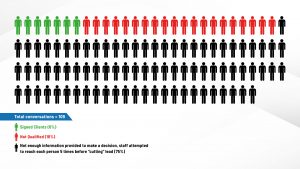
    In February 2018, before TorHoerman Law disrupted their intake process, they were contacted by 109 individuals that believed they would qualify as clients. TorHoerman Law signed 7 clients in February 2018 under the traditional law firm intake model for a case conversion rate of 6.4%.

    Ultimately, the biggest issue was that TorHoerman Law had to reach out to 109 people to gather more information because the traditional intake model generally did not gather enough information to determine case qualification.

    TorHoerman Law had a policy of emailing and calling five times in order to gather more information. In February 2018, that amounted to 45+ hours of staff time spent chasing down leads for 7 signed cases.

    Ultimately, TorHoerman Law determined that they would not be able to help 20 of these individuals, but, in February 2018 there were 82 unreachable individuals, some of which appear to be missed opportunities based on preliminary notes. TorHoerman Law existed under this traditional law firm model for over 3 years and it is the model followed by most law firms today.

    According to Clio Reports 2019 Legal Trend reports 45 % of clients expect to hear from a lawyer within 24 hours, 24% within a few hours and 10 % within an hour. If a law firm reaches out beyond 24 hours, they will not meet the expectations of 79% of potential clients.

    And though most law firms believe they are meeting expectations, 64% of the potential clients surveyed by Clio say they contacted a law firm that never responded to them.

    In SimplyConvert studies, we have found that more than 60% of contacts by potential clients are made outside business hours. Will your firm meet the expectations of legal consumers in 2021 and beyond or do you look more like TorHoerman Law before disrupting their legal intake process?

    What a DISRUPTED law firm intake model looks like

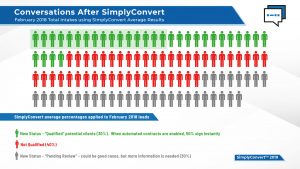
    Conversations-after-SC-300x169The most obvious change to this intake funnel is that every potential client that reaches out is asked relevant, criteria-based questions based on their legal issue from a lawyer taught virtual legal assistant. This eliminates the largest problem with the traditional legal intake model: the unknown.

    Most law firms that have disrupted their outdated intake system will tell you that they find the most value in providing automatic declines to individuals they are unable to assist. This one, simple change will save your firm a significant amount of staff time and frustration.

    The very last improvement, and the single biggest improvement to increasing client conversion rates is the ability to automatically provide contracts to individuals that meet your criteria. Your virtual legal assistant does not sleep, take breaks or take vacation, so your ability to provide a contract to a qualified potential client happens around the clock.

    TorHoerman Law has found that client conversion rates are 30% on average, as opposed to 6% under their outdated legal intake model.

    Disruption is often resisted. But, if you’re still not sold on treating your clients as they hope to be treated, then see if the results don’t convince you. Shutting down Live Chat alone and moving to SimplyConvert will save you 40%. And, if your firm decides to automate contracting to qualified individuals, you can expect to see an increase in signed cases of 500% and a decrease cost per signed case of 80%.

    The last question for you to consider is this one: now that disruption has occurred, who will take advantage of it first – you or your competitor?

    Sources:
    Clio Legal Trends Report 2019: https://www.clio.com/wp-content/uploads/2019/10/2019-Legal-Trends-Report.pdf

  • The Live Chat Problem

    The Live Chat Problem

    The 2020 legal consumer overwhelmingly cites timeliness as one of the most important reasons they hired a lawyer, according to the 2019 Clio Legal Trends Report (“Clio Report”).

    Law firms that don’t challenge pre-2010 solutions for responsiveness will soon lose clients to firms that understand that legal consumers’ expectations have changed significantly in the past decade.

    Live chat companies sold their product as the answer to the responsiveness problem on legal websites for more than ten years, with very little changes made to the product in that decade. If your law firm has been slow to analyze the effectiveness of this tool, you are not alone. According to live chat marketing, over 5,000 legal websites are still counting on live chat to fill the gap.

    In 2020, Live Chat no longer meets consumer expectations. This article analyzes three common live chat claims while considering the 2020 legal consumer:

    1. Live chat fills in the responsiveness gap,
    2. Having live chat is better than not having live chat, and,
    3. Live chat converts website visitors into “leads”.


    Claim #1: Live Chat Fills in the Legal Responsiveness Gap 

    FALSE

    According to the 2019 Clio Legal Trends Report, 82% of clients agreed that timeliness was important. Live chat agents pop up within 17 seconds to engage users, so they certainly are timely.

    But, if you have ever read through a live chat transcript, you will see that live chat agents are not “responsive”, they are merely a website version of a large call center with no dedicated agents. According to the Clio Report, 81% of potential legal clients want a response to questions they ask.

    In 2020, it is important that lawyers give equal weigh to how quickly they respond and how well they respond. Live Chat does not fill this responsiveness gap.


    Claim #2: Live Chat Converts Website Visitors into Leads

    TRUE

    But, peel back the assumptions that are meant to follow this marketing pitch and it becomes clear that converting web visitors into leads at any cost is not helpful to most law firms.

    Live chat is an outreach tool, it does not increase traffic to your website. In order to increase web visitors, law firms must either work on their website optimization (SEO) or pay for ads driving visitors to their site. When a web visitor chooses to reach out to your law firm via live chat, they have chosen not to call you, email you or fill out a form on your website, and its likely those options were free.

    Law firms that don’t add the cost of live chat to their determination of cost per signed clients, are not properly analyzing their return on investment.

    Recently, I dove into three years of live chat data on a mid-sized plaintiff’s law firm to do just that – determine the additional cost per signed client for a firm using live chat consistently. At the time of audit, this law firm was paying $35/chat and were able to reject leads that didn’t pan out within 7 days. They also utilized other outreach tools for web visitors – specifically, detailed questionnaires for each litigation, general contact forms, email and click to call.

    During the 3+ years of using live chat, this firm had 1,764 live chat “leads” at a total cost of just under $40,000. Ultimately, this law firm signed 25 clients from live chat in this 3+ year time frame. Not surprisingly, the other tools decreased in use because a live chat agent engaged visitors after 17 seconds – a time frame that was too quick for a user to complete a form.

    Live chat conversion rates for this law firm was 1% (25 signed cases/1,764 leads). A conversion rate significantly lower than their conversions on phone calls and forms – both of which were free during this time frame.

    The additional cost that live chat added to each signed client for this law firm was $1,590/case.

    This simple cost equation is not good, but it also doesn’t account for the biggest “cost” of live chat – the cost of staff needed to follow up on leads and the cost of opportunities lost to unknowledgeable live chat agents.

    If you are a current or past user of live chat, I don’t need to explain to you how frustrating a long, directionless, live chat transcript is. Most law firms report that intake staff prioritize other leads such as phone calls, web forms and emails before tackling the day’s live chat transcripts, since so few of the live chat leads result in cases.

    Live chat agents are generally not dedicated to a specific law firm and they are not trained in the law. Although most law firms wouldn’t dream of putting someone on their phones that doesn’t know anything about their firm, 5,000 legal websites do just this on their website. These law firms are likely missing opportunities frequently.

    During the audit of the live chat details from this same mid-sized law firm, I found the following “lost opportunity”:

    Live Chat Agent Engages Web Visitor on a Friday at 6:25 pm – An individual sees a TV commercial about the settlement of a drug litigation this law firm had been working on for years. Like many legal consumers, this potential client watched the commercial and searched online for a lawyer to help them. A live chat agent engages the online visitor preventing them from filling out a detailed form that would have collected relevant information from the web visitor.

    The transcript of this lead started with a single simple question by the web visitor, “Does your firm have any clients filing claims for this drug litigation?”. The live chat agent, knowing nothing about the law or this law firm, responded as follows “this law firm has many years of experience in Medical & Mesothelioma however we may be able to assist.”

    That response is not only wrong and nonsensical, it is not an answer to the question the web visitor asked. Not surprisingly, this engagement did not result in a client. It is however considered a “lead” and the firm paid $35 for the engagement.

    Claim #3: Live Chat is Better Than No Live Chat

    FALSE

    The firm that received the above live chat engagement regarding the drug litigation on Friday at 6:25 pm was also testing an automated intake form on their website. This intake form was set to send out automatic contracts for qualified potential clients in this drug litigation.

    If this web visitor had filled out the form instead of being interrupted by a live chat agent, the law firm would have gathered relevant information to determine if the web visitor qualified for the settlement. If the visitor qualified, they would have received a contract immediately and the firm would have been notified of the potential client.

    While there is no guarantee this automated form would have resulted in a client, it is false to say that an agent with no knowledge of the law firm or the litigation engaging web visitors is better than an automated form.